
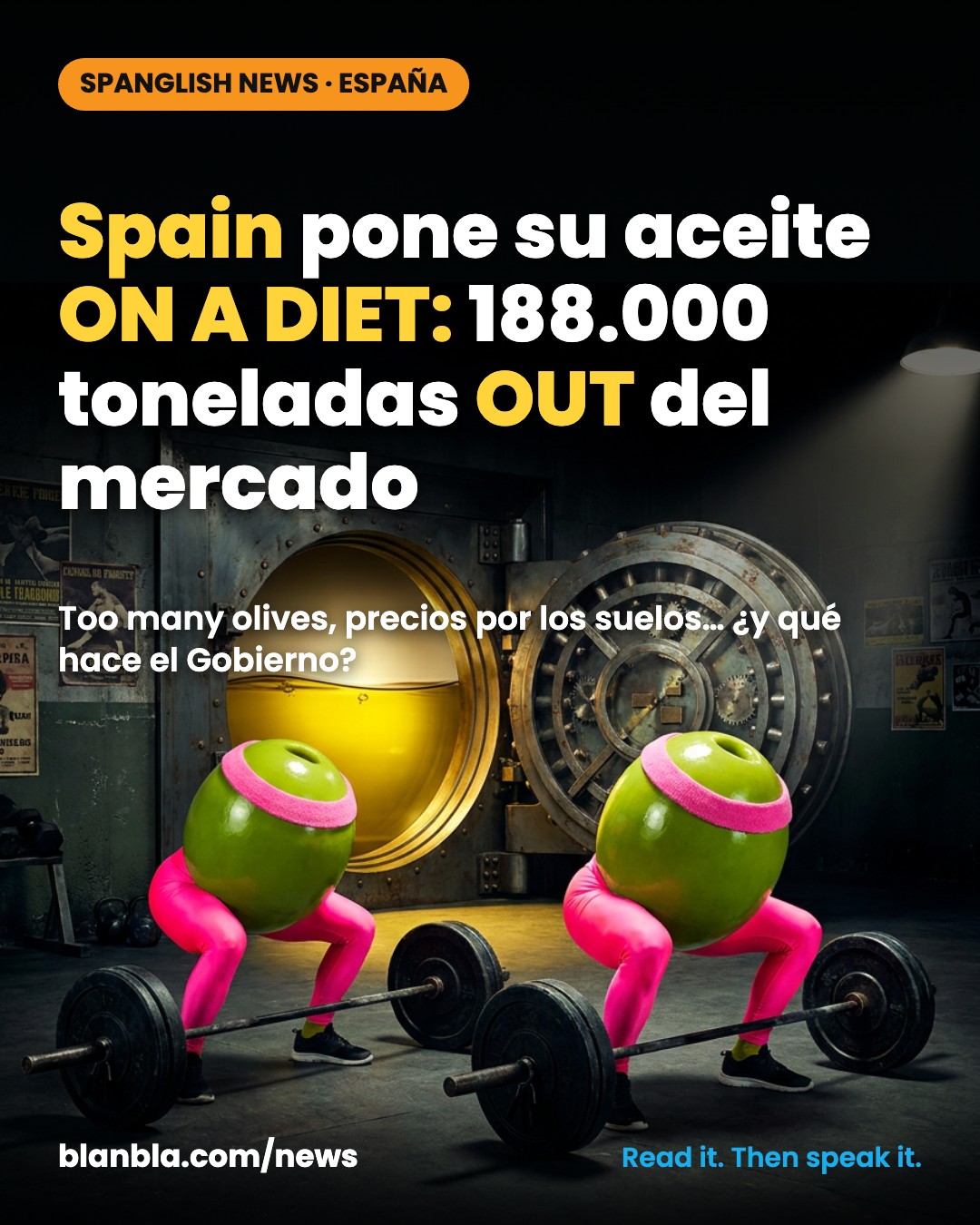
España guarda 188.000 toneladas de aceite de oliva
Spain is storing away 188,000 tonnes of olive oil
España produce mucho aceite de oliva. Es el país número uno del mundo.
Este año hay muchísimas aceitunas. La primavera fue suave y llovió mucho.
Pero hay un problema: si hay demasiado aceite, el precio baja mucho. Y los agricultores ganan poco dinero.
Por eso el Gobierno tiene una idea: guardar una parte del aceite. No se vende ahora. Se vende el año que viene.
Spain produces a lot of olive oil. It’s the number one country in the world.
This year there are lots and lots of olives. Spring was mild and it rained a lot.
But there’s a problem: if there’s too much oil, the price drops a lot. And farmers earn very little money.
So the Government has an idea: store part of the oil. It isn’t sold now. It’s sold next year.
Por primera vez, el Gobierno de España obliga a las almazaras (los lugares donde se hace el aceite) a guardar parte de su producción. Tienen que retirar del mercado el 12 % del aceite que producen desde noviembre: unas 188.000 toneladas.
La cosecha de este año va a ser enorme: más de 1,6 millones de toneladas, un 23 % más que el año pasado. Y además, todavía queda mucho aceite del año anterior.
El objetivo es evitar que el precio caiga demasiado. El aceite guardado no puede salir al mercado hasta el 30 de septiembre de 2027.
España produce cerca del 45 % del aceite de oliva del mundo, y más de 350.000 agricultores viven de él.
For the first time, the Spanish Government is forcing olive oil mills (the places where oil is made) to store part of what they produce. They have to take 12% of the oil they produce from November off the market: around 188,000 tonnes.
This year’s harvest is going to be huge: more than 1.6 million tonnes, 23% more than last year. On top of that, there’s still a lot of oil left over from the year before.
The aim is to stop the price from falling too far. The stored oil can’t go on sale until 30 September 2027.
Spain produces around 45% of the world’s olive oil, and more than 350,000 farmers make a living from it.
Es una medida inédita. El Ministerio de Agricultura, Pesca y Alimentación publicó el 6 de noviembre en el BOE una resolución que obliga a todas las almazaras a retirar del mercado el 12 % de su producción mensual de aceite de oliva durante la campaña 2026/2027: unas 188.000 toneladas en total.
La razón es la sobreproducción. Gracias a una primavera de temperaturas suaves y lluvias abundantes, las comunidades autónomas prevén una cosecha de 1.602.596 toneladas, un 23 % más que la anterior. A eso se suman 357.040 toneladas de existencias de la campaña pasada. Juntas superan el 120 % de la media de las seis últimas campañas, el umbral que activa este mecanismo, previsto en la normativa europea.
Las almazaras pueden elegir qué categoría de aceite almacenan, pero no podrán venderlo hasta el 30 de septiembre de 2027. El Gobierno defiende que así se evita un desplome de los precios y se protege la rentabilidad de los agricultores. La resolución podrá revisarse a partir del 31 de diciembre, según cómo evolucione la cosecha.
It’s an unprecedented move. On 6 November, the Ministry of Agriculture, Fisheries and Food published a resolution in the BOE, Spain’s official gazette, requiring every olive oil mill to take 12% of its monthly olive oil production off the market during the 2026/2027 season: around 188,000 tonnes in total.
The reason is overproduction. Thanks to a spring with mild temperatures and plenty of rain, the regional governments expect a harvest of 1,602,596 tonnes, 23% more than the previous one. Add to that 357,040 tonnes of stock left from last season. Together they exceed 120% of the average of the last six seasons, the threshold that triggers this mechanism under EU rules.
Mills can choose which grade of oil they store, but they won’t be able to sell it until 30 September 2027. The Government argues that this prevents a price crash and protects farmers’ profitability. The resolution can be reviewed from 31 December, depending on how the harvest develops.
Palabras clave
Tu turno
¿Usas aceite de oliva en tu casa? ¿Para qué? ¿Te parece bien guardar comida para que el precio no baje?
Say your answer out loud. In Spanish. Badly, if necessary.