
TL;DR:
- Online conversation practice helps bridge the Spanish comprehension gap effectively.
- Choosing the right platform depends on your goals, budget, and comfort level.
- Consistent, real-time speaking exercises build confidence and improve fluency faster than traditional study.
You understand Spanish. You can follow a conversation, read a menu, and catch most of what people say in a movie. But the moment someone asks you a question in Spanish, your mind goes blank. This is called the comprehension gap, and it affects a huge number of intermediate learners. Understanding a language and speaking it are two completely different skills. The good news is that online conversation practice is one of the fastest ways to close that gap. This guide walks you through the best tools, how to set up your first session, how to handle common problems, and how to track real progress.
Table of Contents
- Getting ready: Tools and resources for online Spanish practice
- Step-by-step: Setting up your first online conversation session
- Troubleshooting: Overcoming common obstacles in online practice
- Verification: Tracking speaking progress and staying motivated
- Our take: Why online practice is more effective than traditional study
- Ready to boost your Spanish conversation skills?
- Frequently asked questions
Key Takeaways
| Point | Details |
|---|---|
| Practice tools overview | Platforms, apps, and AI tutors each offer unique ways to improve your Spanish speaking online. |
| Step-by-step setup | Following clear steps helps you start online Spanish conversations confidently, even if you’re nervous. |
| Troubleshooting strategies | Common obstacles are easily overcome with the right tips, like using AI for low-pressure practice. |
| Progress tracking | Measuring and reflecting on your speaking helps you stay motivated and see real-world improvement. |
| Online vs. traditional | Online practice builds fluency faster than classroom study thanks to real-time conversations. |
Getting ready: Tools and resources for online Spanish practice
Before you book a session or download an app, it helps to understand what kinds of tools are out there. Not every platform works the same way, and choosing the wrong one can leave you frustrated before you even start.
Paid tutoring platforms are the most structured option. Platforms like italki, LanguaTalk, and Baselang offer 1-on-1 online conversation practice with native Spanish speakers or vetted tutors. Prices vary widely. italki tutors typically range from $10 to $40 per hour depending on experience. Baselang offers an unlimited subscription model starting around $149 per month, which is ideal if you want daily practice. LanguaTalk sits in the middle, with structured lesson packages and experienced tutors.
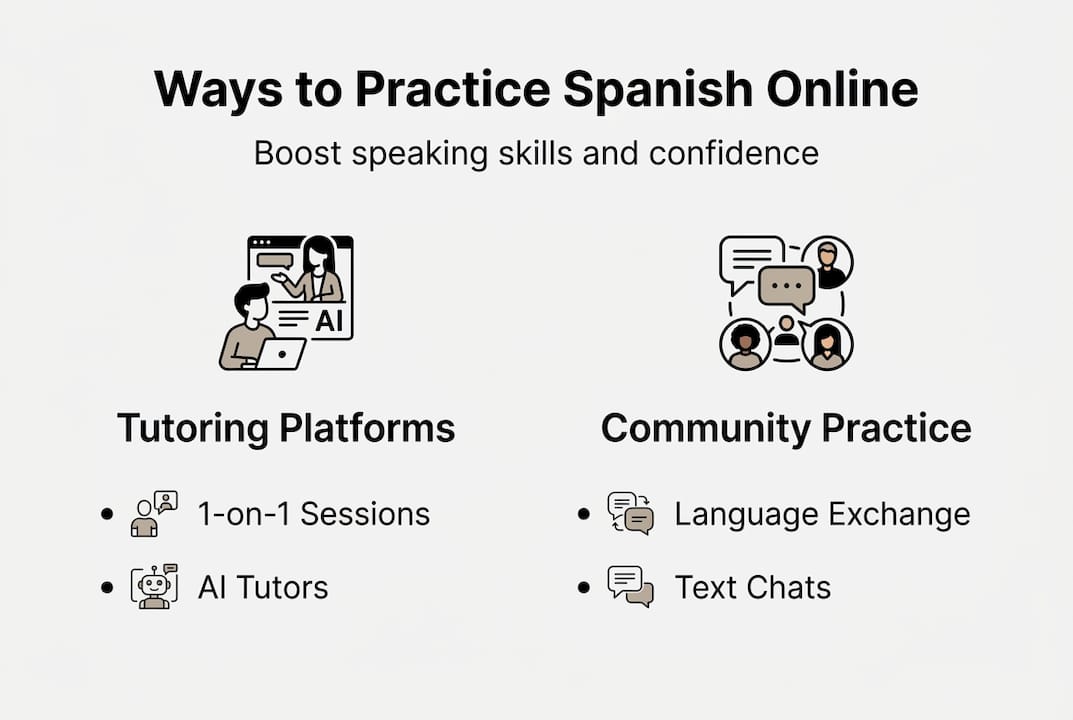
Language exchange apps take a different approach.
AI tutors like Langua are worth mentioning for anyone who feels too nervous to jump straight into a live conversation. You can practice speaking at your own pace, get instant feedback, and build enough confidence to move on to real people.
Here is a quick comparison to help you decide:
| Tool | Cost | Format | Best for |
|---|---|---|---|
| italki | $10 to $40/hour | 1-on-1 with tutor | Structured learners |
| Baselang | ~$149/month | Unlimited lessons | High-volume practice |
| HelloTalk | Free | Peer exchange | Casual, flexible practice |
| Tandem | Free/Premium | Peer exchange | Text and voice chat |
| Langua (AI) | Low cost | Solo AI chat | Anxious beginners |
Here are some quick picks based on your situation:
- Tight budget: Start with HelloTalk or Tandem for free exchanges
- Fast results: Baselang for daily immersion
- Nervous speaker: Langua AI tutor as a confidence builder
- Structured learning: italki with a professional tutor
- Free self-study: Check out free Spanish study resources to supplement your sessions
For a broader view of how all these tools fit into your learning journey, the ultimate Spanish learning guide is a great place to start.
Step-by-step: Setting up your first online conversation session
Once you’ve decided on a tool, here’s how you can set up your first speaking session without stress.
- Choose your platform based on comfort. If anxiety is your main issue, start with an AI tutor or a text-based exchange on Tandem. If you are ready for live video, go straight to italki or Baselang.
- Create your profile honestly. Write a short bio that explains your level and your goals. Something like: “I understand Spanish well but want to practice speaking. I am patient and love talking about travel and food.” This attracts the right partners.
- Write a warm intro message. When reaching out to a tutor or exchange partner, keep it friendly and specific. Mention what you want to work on. Vague messages get ignored.
- Schedule your session and prepare. Before the call, write down 5 to 10 topics or questions you can use if the conversation stalls. Topics like your job, your city, or your favorite food work well.
- Do a tech check. Test your microphone and camera 10 minutes before the session. A Baselang for intensive practice review notes that high-volume practice and daily lessons drive rapid fluency gains, but only if the technical setup runs smoothly.
Language exchange apps enable mutual corrections and community support, which means your partner can gently flag errors in a way that feels natural rather than like a test.
For extra confidence before your first call, read through these Spanish speaking tips to get your mindset right. And if you want to understand what it feels like to practice with native speakers, [Spanish learning with natives](https://blanbla.com/n-spanish-learn-spanish-with-native speakers-2) gives you a real picture of what to expect.
Pro Tip: If video calls feel too intense at first, spend one week doing text-only chats on HelloTalk. Once you feel comfortable writing in Spanish in real time, the jump to voice is much smaller than you think.
Troubleshooting: Overcoming common obstacles in online practice
After your first session, you’re likely to hit some speed bumps. Here’s how to handle them.
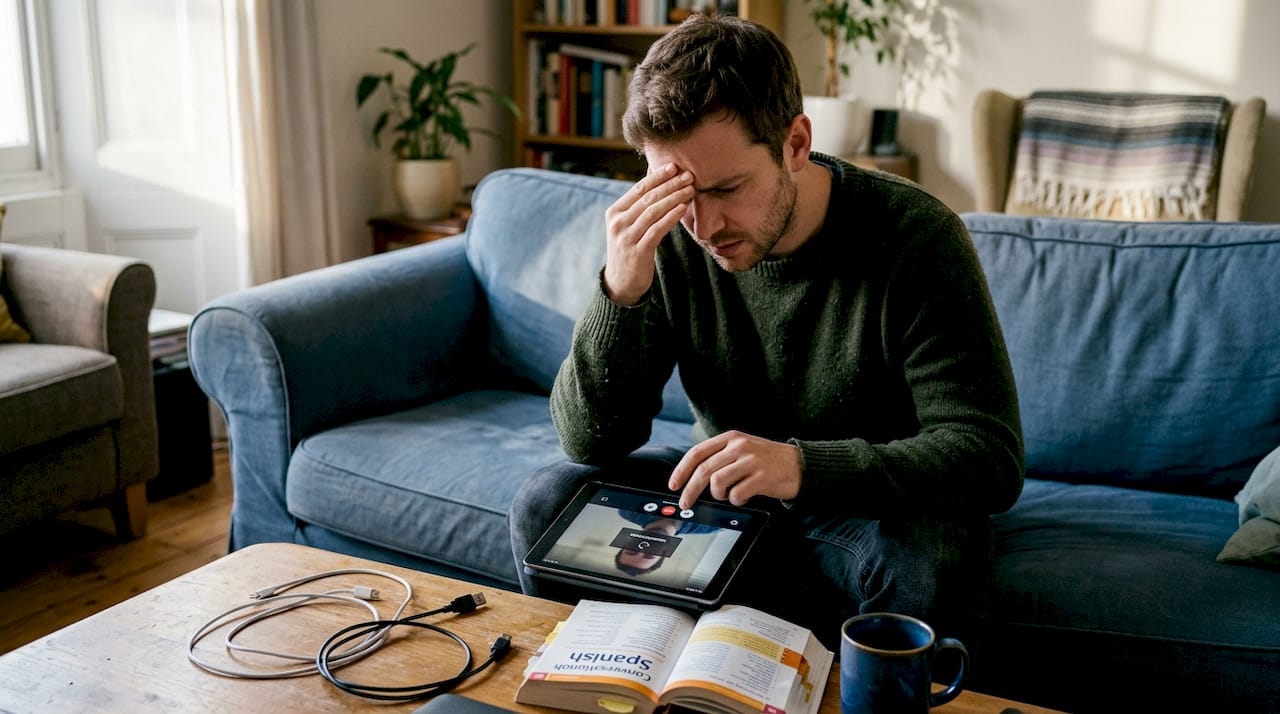
The most common issue is stage fright. Your heart races, your vocabulary disappears, and you end up nodding and saying “sí” to everything. This is completely normal. The solution is not to push through the fear immediately. Instead, lower the pressure first.
AI tutors like Langua provide instant feedback and low-pressure practice, making them a smart starting point for anxious speakers. Once you have had a few sessions with an AI, the idea of talking to a real person feels far less scary.
Low-pressure practice with AI tutors builds the confidence you need to face real conversations without freezing up.
Technical problems are the second biggest frustration. Bad audio, laggy video, or time zone mix-ups can kill a session before it starts. Fix these in advance by testing your setup, confirming the time zone in writing, and having a backup plan like switching to voice-only if video fails.
Miscommunication and correction etiquette can also feel awkward. If your partner corrects you too much, it breaks the flow. If they never correct you, you repeat the same mistakes forever. Set expectations early. Tell your partner: “Please correct me if I make a grammar mistake, but let me finish my sentence first.”
Here is a practical checklist to keep sessions smooth:
- Use an AI tutor for 1 to 2 weeks before live sessions
- Pick safe, familiar topics for early conversations
- Set clear expectations about correction style with your partner
- Test audio and video 10 minutes before every session
- Keep a list of backup topics in case conversation stalls
For a solid foundation before you start troubleshooting, the Spanish beginner guide covers the basics that make live practice much easier.
Verification: Tracking speaking progress and staying motivated
To keep growing and avoid losing momentum, let’s see how you can check your speaking progress and keep yourself inspired.
Progress in speaking is hard to see because it happens gradually. The best way to notice it is to create evidence of where you started. Record a 2-minute voice clip of yourself speaking Spanish on day one. Talk about your daily routine, your job, or your weekend plans. Save it. Listen back in four weeks. You will be surprised.
Here is a simple progress tracking routine:
- Record a short voice clip every two weeks on the same topic
- Compare clips and note where you hesitated less or used more vocabulary
- Write a speaking log after each session: what went well, what felt hard, what words you forgot
- Set a milestone every month, such as holding a 5-minute conversation without notes
- Reward yourself when you hit a milestone. It sounds simple, but it works.
When it comes to the best approach, daily immersion and weekly lessons each have their place:
| Approach | Best for | Result timeline | Effort level |
|---|---|---|---|
| Daily immersion (Baselang) | Fast fluency gains | 1 to 3 months | High |
| Weekly tutor sessions | Steady structured growth | 3 to 6 months | Moderate |
| Peer exchange (daily) | Casual, consistent practice | 2 to 4 months | Low to moderate |
| Mixed approach | Balanced learners | 2 to 5 months | Moderate |
Unlimited platforms like Baselang accelerate fluency by allowing daily immersion, which means more speaking time per week than any traditional class can offer.
Staying motivated long-term also means joining a community. Find a Spanish learning group online, join a Discord server, or connect with others who are at your level. Shared accountability is one of the most underrated tools in language learning. For deeper strategies, Spanish speaking mastery walks you through what consistent practice really looks like over time.
Our take: Why online practice is more effective than traditional study
Here is our honest perspective after working with hundreds of Spanish learners who understood the language but could not speak it.
Traditional classroom study is great for building a foundation. But it almost never trains you for the unpredictability of a real conversation. You memorize verb tables, you fill in blanks, and then someone speaks to you at natural speed and you freeze. That is not a knowledge problem. It is a practice problem.
Daily online practice accelerates speaking skills by offering real-world interaction and instant feedback, something a textbook simply cannot replicate. Online platforms force you to respond in real time, make mistakes in front of someone, and keep going anyway. That discomfort is where the real learning happens.
Our hard-won lesson: consistency beats perfection every time. A learner who has five messy 20-minute conversations per week will outpace someone who studies grammar for two hours on weekends. The goal is communication, not flawless sentences. For more on this mindset, the speaking guide insights lay it out clearly.
Pro Tip: Stop waiting until your Spanish is “good enough” to practice speaking. It will never feel good enough. Start now, speak badly, and improve fast.
Ready to boost your Spanish conversation skills?
If you’re ready to turn advice into action, here’s where you can find more support and resources.
At Blanbla, we built everything around one idea: you learn to speak Spanish by speaking Spanish, not by studying it. Our small group conversation sessions put you in real conversations from day one, with guidance and a supportive community around you.
Start by exploring how to study Spanish for free with our beginner-friendly resources. If you want to work on the basics, our guide to present tense Spanish verbs is a great warm-up. And when you are ready for real conversation, come practice Spanish with native speakers in a space designed exactly for learners like you.
Frequently asked questions
What is the best platform for online Spanish conversation practice?
Platforms like italki and Baselang are popular for structured 1-on-1 sessions, while HelloTalk and Tandem offer free peer-to-peer exchanges for more casual practice.
How can I overcome anxiety when speaking Spanish online?
Start with AI tutors or text-only chats to build your confidence, then move to video sessions once speaking feels less overwhelming. AI tutors provide 24/7 solo practice with instant feedback, making the transition to live conversations much smoother.
Is daily practice necessary for fluency gains?
Daily immersion makes a significant difference. Unlimited plans like Baselang enable high-volume practice that accelerates fluency far faster than occasional weekly sessions.
Can I practice Spanish online for free?
Yes. Apps like HelloTalk and Tandem offer free conversation practice with native speakers through peer exchange, with no subscription required to get started.
Recommended
- Learn Spanish: Learn Spanish with Native Speakers – Blanbla
- Learn Spanish: The Ultimate Guide to Speaking in Spanish – Blanbla
- Learn Spanish: Your Ultimate Guide to Mastering the Language – Blanbla
- Learn Spanish: Beginner’s Guide to Mastering the Language – Blanbla
Article generated by BabyLoveGrowth
Practice Spanish Online from Perth
Perth learners have a real advantage — online Spanish practice means working with a native teacher from Madrid without leaving WA. BlanBla’s classes are designed around online Spanish conversation practice for Perth students, with sessions on Perth time (AWST) Monday to Saturday. See your options on our Spanish classes Perth page.
Subscribe for Free Spanish Tips
Get conversation tips, vocab guides and resources for Australian learners delivered to your inbox.
[mailerlite_form form_id=4]— Monica Bernabe Perez