
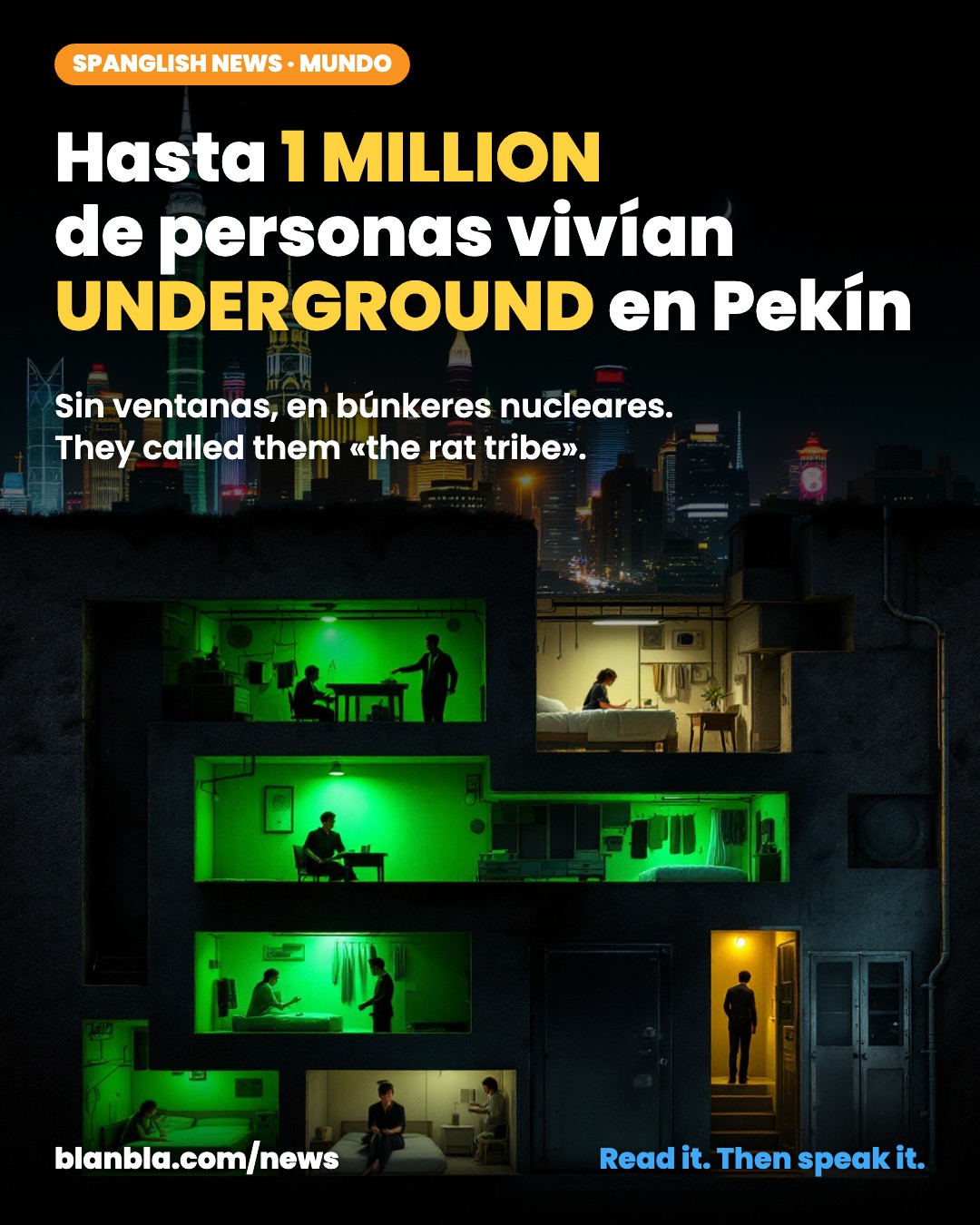
La ciudad secreta bajo Pekín donde vivía hasta un millón de personas
The secret city under Beijing where up to a million people lived
Pekín es una ciudad enorme. Tiene más de 20 millones de personas. Los pisos son muy caros.
Debajo de los edificios hay sótanos y refugios muy antiguos.
Muchas personas jóvenes viven allí, bajo tierra. Sus habitaciones no tienen ventanas.
Trabajan en la ciudad: son camareros, cocineros, peluqueras…
La gente los llama “la tribu de las ratas”. Es un nombre muy feo.
Beijing is a huge city. It has more than 20 million people. Flats are very expensive.
Under the buildings there are very old basements and shelters.
Lots of young people live there, underground. Their rooms have no windows.
They work in the city: they are waiters, cooks, hairdressers…
People call them “the rat tribe”. It’s a very ugly name.
Durante la Guerra Fría, China construyó miles de refugios bajo sus ciudades. Eran para protegerse de una posible guerra nuclear.
La guerra nunca llegó. Con los años, muchos refugios y sótanos de Pekín se convirtieron en habitaciones de alquiler baratas.
Entre 2010 y 2015, periodistas y fotógrafos contaron que, según algunos cálculos, hasta un millón de personas vivían bajo tierra en Pekín. Eran sobre todo jóvenes que llegaban del campo a buscar trabajo.
Pagaban poco y vivían cerca del trabajo. A cambio, no tenían luz natural ni aire fresco.
En 2010 el gobierno prohibió vivir en estos espacios, pero mucha gente se quedó. Después, la ciudad empezó a cerrarlos y a desalojar a sus habitantes.
During the Cold War, China built thousands of shelters under its cities. They were to protect people from a possible nuclear war.
The war never came. Over the years, many of Beijing’s shelters and basements became cheap rooms to rent.
Between 2010 and 2015, journalists and photographers reported that, according to some estimates, up to a million people were living underground in Beijing. Most of them were young people from the countryside looking for work.
They paid little and lived close to work. In exchange, they had no natural light and no fresh air.
In 2010 the government banned living in these spaces, but many people stayed. Later, the city started closing them and evicting the people who lived there.
Estos días circula por redes un vídeo viral: en Pekín, dice, hay gente que vive “en tuberías”. La historia real es distinta, más antigua y, en cierto modo, más impresionante.
Bajo los rascacielos de Pekín hay una ciudad subterránea: miles de sótanos y refugios antiaéreos construidos durante la Guerra Fría por miedo a una guerra nuclear. Cuando ese miedo pasó, se dividieron en habitaciones diminutas, sin ventanas, que se alquilaban a precios imposibles de encontrar en la superficie.
Allí vivían camareros, peluqueras, cocineros y guardias de seguridad: la gente que hace funcionar la ciudad. Los medios los apodaron shuzu, “la tribu de las ratas”. La fotógrafa Sim Chi Yin los retrató durante cinco años para demostrar lo contrario: eran jóvenes trabajadores con grandes aspiraciones.
En 2010 se prohibió alquilar estos espacios como vivienda y, entre 2015 y 2017, Pekín hizo una gran campaña para cerrarlos. Hubo incluso un caso de personas que entraban a su casa por una tapa de alcantarilla: las autoridades la sellaron y las desalojaron.
Así que no, no viven en tuberías. Pero la pregunta sigue ahí: ¿qué estarías dispuesto o dispuesta a aguantar para vivir en la ciudad de tus sueños?
There’s a viral video going around social media right now: in Beijing, it says, people are living “in pipes”. The real story is different, older and, in a way, more striking.
Under Beijing’s skyscrapers there is an underground city: thousands of basements and air-raid shelters built during the Cold War out of fear of a nuclear war. When that fear faded, they were divided into tiny windowless rooms, rented out at prices you could never find above ground.
The people living there were waiters, hairdressers, cooks and security guards: the people who keep the city running. The media nicknamed them shuzu, “the rat tribe”. Photographer Sim Chi Yin spent five years taking their portraits to prove the opposite: they were young workers with big ambitions.
In 2010, renting these spaces out as homes was banned, and between 2015 and 2017 Beijing ran a big campaign to close them. There was even a case of people getting into their home through a manhole cover: the authorities sealed it and evicted them.
So no, they don’t live in pipes. But the question is still there: what would you put up with to live in the city of your dreams?
Palabras clave
Tu turno · Nivel 1
- ¿Cuántas personas viven en Pekín?
- ¿Cómo son las habitaciones bajo tierra?
- ¿En qué trabajan estas personas?
- Y tú, ¿cómo es tu casa? ¿Tiene muchas ventanas?
- How many people live in Beijing?
- What are the underground rooms like?
- What jobs do these people do?
- And you: what is your home like? Does it have lots of windows?
- ¿Para qué construyó China los refugios?
- ¿Por qué los jóvenes vivían bajo tierra?
- ¿Qué pasó en 2010?
- ¿Dónde vivías cuando tenías veinte años? ¿Cómo era tu casa?
- Why did China build the shelters?
- Why did young people live underground?
- What happened in 2010?
- Where did you live when you were twenty? What was your home like?
- ¿Por qué crees que los medios los llamaron “la tribu de las ratas”? ¿Te parece justo?
- ¿Qué elegirías: una habitación sin ventanas en el centro o un piso con luz a dos horas del trabajo? ¿Por qué?
- Muchas noticias virales exageran. ¿Cómo compruebas si algo que ves en redes es verdad?
- ¿Hay un problema de vivienda parecido en tu ciudad? Explícalo.
- Why do you think the media called them “the rat tribe”? Do you think it’s fair?
- Which would you choose: a windowless room in the city centre or a bright flat two hours from work? Why?
- Lots of viral news stories exaggerate. How do you check whether something you see on social media is true?
- Is there a similar housing problem in your city? Explain it.