
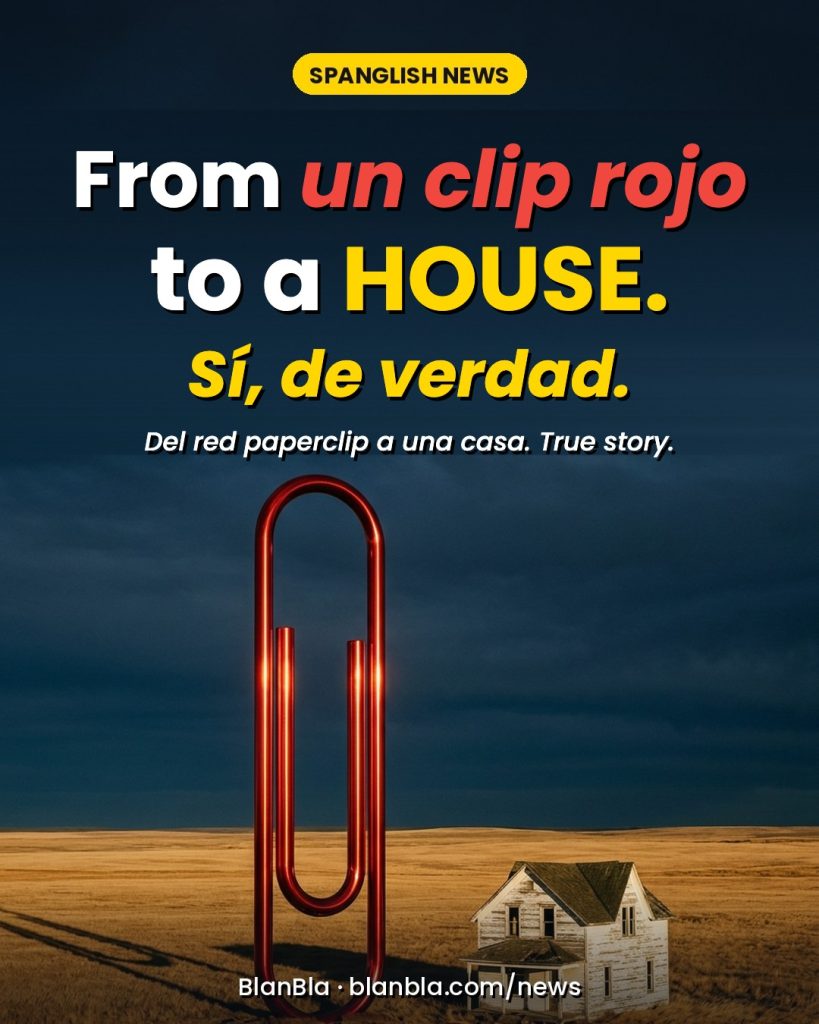
Quick answer: in 2005 a Canadian blogger, Kyle MacDonald, traded one red paperclip for a pen, the pen for a doorknob… and fourteen trades later he had a house. No single trade was a big jump. Learning Spanish works exactly the same way: you don’t go from “hola” to fluent in one move. You trade up, paso a paso.
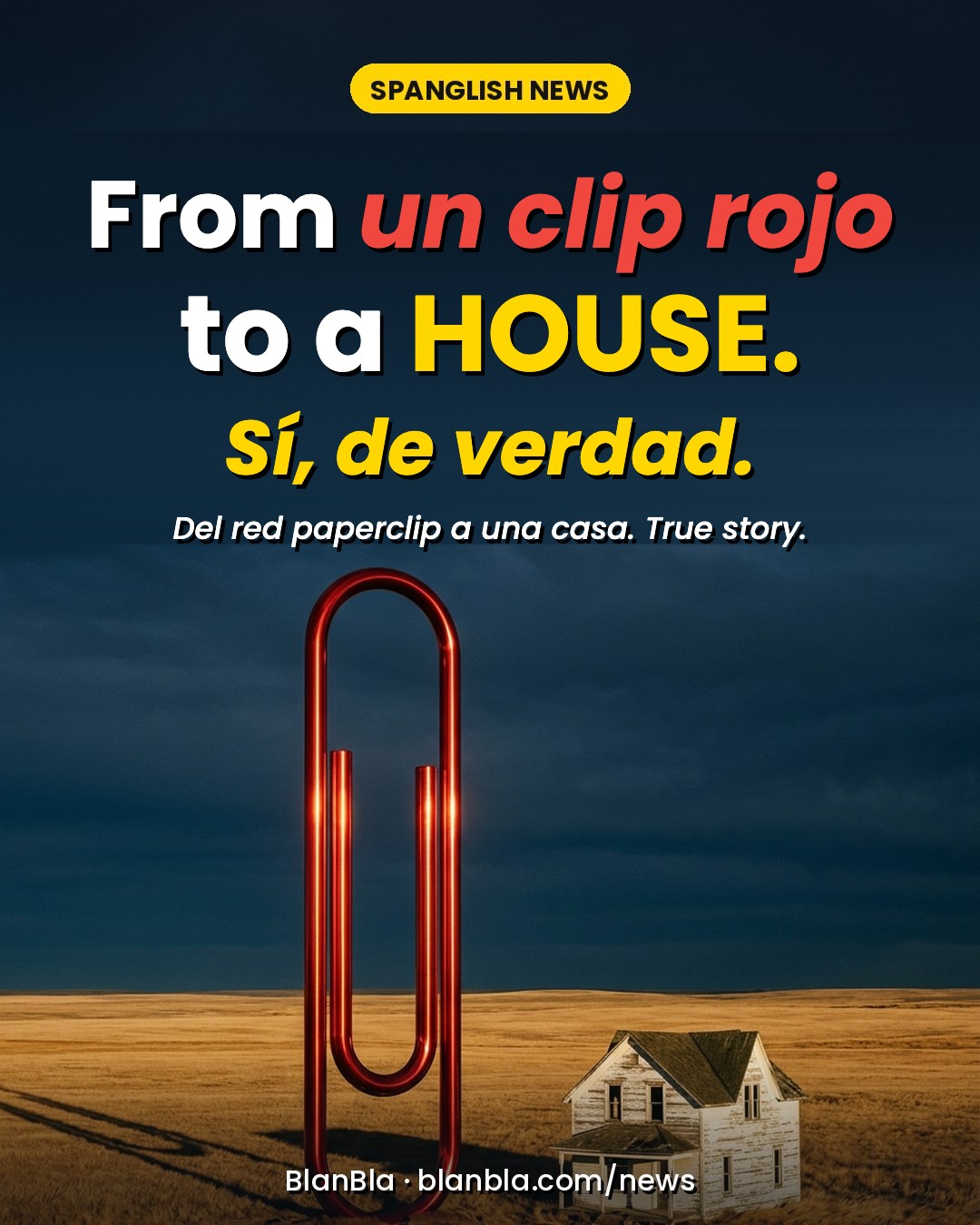
Un clip rojo, una casa
Kyle was 26, lived in Montreal and was tired of paying el alquiler (rent). One day in July 2005 he looked at a red paperclip on his desk and decided to play a game: cambiar el clip por algo un poco mejor. And then do it again. And again.
The paperclip became a fish-shaped pen. The pen became a doorknob. Then a camping stove, a generator, an “instant party” (an empty keg and a neon sign), a snowmobile, a trip, a van, a recording contract, a year’s rent in Phoenix, an afternoon with Alice Cooper and a KISS snow globe.
The actor Corbin Bernsen, a snow-globe collector, gave him a film role for that globe. And the small town of Kipling, in Saskatchewan, offered a house in exchange for the role. On 12 July 2006, 14 trueques after the paperclip, Kyle had una casa.
You can read the whole story in Spanish and English, in three levels and with audio, here: Cambió un clip rojo por una casa.
Your Spanish is a red paperclip (and that’s fine)
Most people who freeze when they speak Spanish are trying to trade the paperclip for the house in one go. They want to say the perfect sentence, with the perfect subjunctive, at the perfect speed. So they say nothing.
Kyle never asked for a house. He asked for something un poco mejor. That’s the whole trick:
- Clip: “Hola, ¿qué tal?” Yes, it counts.
- Boli: one sentence about your day, in the present: “Hoy trabajo en casa.”
- Pomo: one sentence in the past: “Ayer cambié mi clip por un boli.”
- Estufa: a short story with “primero… después… al final…”.
- Casa: a real conversation where you forget you’re speaking Spanish.
Every small trade makes the next one easier. That’s not a motivational poster; it’s how memory works. You remember the words you actually used, not the ones you highlighted.
The value was in the story
Here’s the part I love. A doorknob isn’t worth much more than a pen. What grew with every trade was la historia: more people followed it, so every next trade was easier to get.
Same with Spanish. A list of 500 verbs is a paperclip. A story you can tell (what happened to you, a funny news story, a bull that walked into a bar) is a house. That’s why at BlanBla we learn with real news: you get the words and something to say with them.
Spanglish tip: cambiar POR, not para
In Spanish you cambias algo POR algo: “Cambió el clip por un boli” = he traded the paperclip for a pen. Para is the goal: “Lo hizo para tener una casa” = he did it to get a house.
One sentence, both words: “Cambió un clip por un boli para llegar a una casa.” Say it out loud three times. Badly, if necessary.
Tu turno
What’s your red paperclip today? Pick one tiny Spanish thing you can do in the next ten minutes: one sentence, one voice note, one news story at level 1. Then tomorrow, trade it for something un poco mejor.
If you want a few paperclips to start with, grab my free Spanish resources: guides, phrases and audios to stop freezing when you speak. And when you’re ready for a doorknob, the Spanglish News are waiting (the first three are free).
Sources: CBS News / Associated Press (July 2006) and Wikipedia, “One red paperclip”.
— Monica Bernabe Perez
$54 · 30 minutes · with Mónica
Want to speak Spanish like this, not just read it?
Book your Spanish Speaking Roadmap call ($54), or add it for $27 when you buy my book. We find what is blocking you and the fastest way to start speaking real Spanish.
Book my call ($54) →